

The Short Version
I think the DJI Mini 4 Pro is still the drone most people should buy in 2026, and I’ll tell you why. It weighs a mere 249g (0.549 lbs), shoots impressive 4K/60fps HDR video, has obstacle sensing in every direction, and captures 48MP RAW stills. It avoids FAA registration for recreational flyers in the US and sits under the threshold for licensing requirements across most of Europe and the rest of the world. And right now, for those of you in the US it has something going for it that its successor doesn’t have, you can actually buy it through normal US retailers, with full warranty and without paying a reseller premium.
What You’re Actually Getting
Let’s start with the camera, since that’s one of the main reasons most people look at this little quadcopter.
The DJI Mini 4 Pro uses a 1/1.3-inch CMOS sensor, just like the Mini 3 Pro before it. On paper that might sound like a disappointment but DJI upgraded the image processing platform and the results show it, the images are clearly better. Video on the Mini 4 Pro now tops out at 4K/60fps and you have 4K/100fps available for slow motion. This is a great addition as it allows you to slow footage down even more and helps you create those cinematic effects. For stills images, aka photos, you get 48MP images in both JPEG and DNG RAW format. This is enough to give you a lot of flexibility when you want to edit your photos. The DNG files hold a good amount of shadow detail and they respond well to editing. You can get some amazing results when you finish your post processing. Despite its tiny size, the DJI Mini 4 Pro isn’t a drone where you’re stuck with processed JPEGs if you don’t want that. That said, the JPEG pictures are good enough already for most people. I happily accept them when I don’t feel like spending the extra time editing.
For color work, the DJI Mini 4 Pro supports 10-bit D-Log M and HLG profiles, which means you have enough dynamic range to play with if you want to grade your footage. For most people though, the standard color modes will look great straight off the drone. However, it’s good to know that you can take your footage to another level, or in another creative direction, you can do this.
There is still one problem though and that’s related to low-light performance. It’s decent and it has definitely improved over the Mini 3 Pro but because of the smaller sensor it means you’ll see noise in genuinely dark conditions. To me, it’s not a deal breaker. But, if high quality low-light footage is a priority, the Mini 5 Pro’s larger 1-inch sensor is better and is worth considering instead. More on that shortly.
Flying the Mini 4 Pro
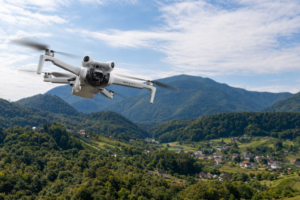 DJI’s reputation for making drones that are intuitive to fly is well-earned, and the DJI Mini 4 Pro is no exception. The omnidirectional obstacle sensing, one of the key upgrades over the Mini 3 Pro’s three-directional system, works reliably. It uses an omnidirectional vision system to detect obstacles from any angle, and in practice it does what it’s supposed to do. Granted, this is not a feature that everybody needs. But if you’re trying to track that mountain biker racing, or just your kid running, through the forest you’ll definitely feel a lot better knowing it’s there.
That said, a word of caution: the sensors are deactivated during some automated flight modes, so you can’t switch to autopilot and stop paying attention entirely.
ActiveTrack 360° is genuinely useful as well. It tracks a moving subject from any angle, not just from behind, and holds the framing well even when the subject changes direction. For solo content creators like cyclists, hikers, or really anyone filming themselves without a second person on the controller, this is probably the feature that justifies the upgrade over cheaper alternatives. For me personally I think it’s a great travel drone. Even if you don’t travel alone it’s still nice that more people can easily be in the shot at the same time and nobody is left out because they have to fly the drone.
And although it’s tiny, flight time is rated at 34 minutes with the standard battery. Now to be fair, that’s in optimal conditions. In the real world you are more likely to get anywhere from 27 to 30 minutes with normal flying, and closer to 22 minutes in windy conditions or if you’re flying very aggressively. Flying all out always drains the battery faster than a lot of people would expect. Can you get to those 34 minutes of flight time? Probably. But I don’t know anybody who has done that. And to be honest, the real world flight times are still in line with the rest of the industry for this weight class. Aside from that, DJI also offers the Intelligent Flight Battery Plus which extends flight time to 45 minutes, again under ideal circumstances. I can’t tell you what the real-world times are as I have no experience with the Battery Plus but expect them to be shorter than 45 minutes. And, there is a catch that you need to be aware of.
The 249g Question
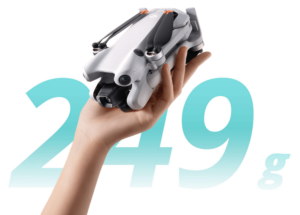
The sub-250g weight is the Mini series’ signature feature, and it truly matters for regulatory reasons. In the US, drones under 250g (0.55 lbs) don’t require FAA registration for recreational flying. In most of Europe, the sub-250g classification puts the drone in the Open Category A1, meaning you can fly near people without a licence. These benefits may not sound like much to some of you but they aren’t trivial. Registration and licensing requirements add cost and paperwork, and the Mini 4 Pro sidesteps both.
But I told you there’s a catch you need to be aware of so here it is: the Intelligent Flight Battery Plus, which gives you a lot more flight time, pushes the drone above 249g. That means if you’re using the Plus battery, the regulatory exemptions no longer apply and you’d need to register the drone. DJI does flag this in their documentation, but it’s easy to miss when you’re looking at bundle options. So if staying under the threshold matters to you, stick with the standard battery and just accept the somewhat shorter flight time. In my experience a second battery is just as useful, if not more so, in most scenarios.
To keep the weight down there’s also no AirSense transponder on the DJI Mini 4 Pro. AirSense detects nearby manned aircraft and warns you of potential conflicts. It is a safety feature that larger DJI drones do include and it can be very convenient to have. That said, when you only fly recreational this is not something that should worry you. And even if you’re flying commercially, I can see situations where it might be beneficial to grab the Mini instead of a full sized quadcopter, it just means you need to be a bit more situationally aware if you’re working with other drone operators in the area.
The Mini 5 Pro Situation
The honest answer to “should I buy the DJI Mini 4 Pro or wait for the Mini 5 Pro” is more complicated than usual right now for a large number of you, for reasons that have nothing to do with the drones themselves.
The Mini 5 Pro is a real upgrade as it has a larger 1-inch sensor, 4K/120fps slow motion, front-facing LiDAR for obstacle sensing in low light, and a more flexible gimbal with 225 degrees of rotation. For serious content creators, especially anyone shooting in challenging light conditions, those are incredibly meaningful improvements.
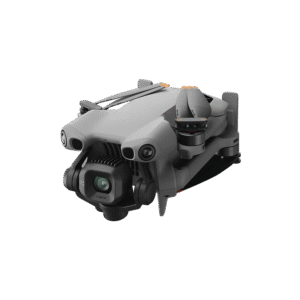
But, unfortunately the Mini 5 Pro is not officially available in the US. DJI is navigating FCC authorization issues that have affected their ability to launch new products in the American market, and the Mini 5 Pro launched globally without a US release. Of course units are reaching US buyers but they come through third-party importers, at higher prices and without the warranty support you’d get from an authorised retailer. The DJI Mini 4 Pro, by contrast, is fully stocked at for instance Amazon, B&H, and Adorama at its standard price.
Outside the US, the picture is different. In the UK and Europe the Mini 5 Pro is available at normal retail prices, and the price difference between the two is roughly $140 to $200 depending on the configuration and the country you’re in. If you’re looking to buy in Europe and your budget allows for it, the Mini 5 Pro is worth paying the extra. If you’re in the US, or your budget is not so flexible, the DJI Mini 4 Pro is the sensible choice right now.
If you still want to look at the Mini 5 Pro though, you can check the price here
How It Compares
| Model | Weight | Video | Sensor | Flight Time |
|---|---|---|---|---|
| DJI Mini 4 Pro | 249g / 0.549 lbs | 4K/60fps HDR | 1/1.3-inch | 34 min |
| DJI Mini 5 Pro | 249.9g / 0.551 lbs* | 4K/120fps HDR | 1-inch | 36 min |
| DJI Mini 3 Pro | 249g / 0.549 lbs | 4K/30fps HDR | 1/1.3-inch | 34 min |
| Autel EVO Nano+ | 249g / 0.549 lbs | 4K/30fps | 1/1.28-inch | 28 min |
*The Mini 5 Pro is officially rated at 249.9g with a tolerance of plus or minus 4g. Some units have been reported above 250g, which affects the regulatory exemption. Worth checking before you buy.
The Honest Summary
Buy it if: you want a capable, portable drone for travel or content creation, you’re in the US and want to buy through normal retail channels, you fly near obstacles and want reliable obstacle sensing, or you want 4K/60fps with RAW stills in a sub-250g package.
Look elsewhere if: you’re in Europe and the Mini 5 Pro is within budget, low-light shooting is a priority, you need RAW video rather than just RAW stills, or you regularly fly in strong winds and want more stability from a heavier platform.
The DJI Mini 4 Pro isn’t the newest drone in DJI’s Mini lineup, and it doesn’t pretend to be. But it’s proven, well-supported, and available, which in the current US market counts for more than it used to.
Specs
| Weight | 249g / 0.549 lbs (standard battery) |
| Camera sensor | 1/1.3-inch CMOS |
| Photos | 48MP JPEG and DNG RAW |
| Video | 4K/60fps HDR, 4K/100fps slow motion |
| Color profiles | 10-bit D-Log M, HLG |
| Flight time | 34 min (standard) / 45 min (Plus battery: over 249g) |
| Range | 20km / 12.4 miles (FCC) – 10km / 6.2 miles (CE) |
| Obstacle sensing | Omnidirectional |
| Wind resistance | 10.7 m/s / 23.9 mph (Level 5) |
| Max speed | 16 m/s / 35.8 mph (Sport mode) |
| Operating temp | -10 to 40°C / 14 to 104°F |
| Transmission | DJI O4 |
Common Questions
Does the DJI Mini 4 Pro need FAA registration? Not for recreational flying with the standard battery. At 249g it falls under the 250g threshold but you still need to pass the free TRUST test. Using the Intelligent Flight Battery Plus pushes the weight over 249g and changes this.
Does the DJI Mini 4 Pro shoot RAW? Yes. The DJI Mini 4 Pro shoots 48MP DNG stills. That said, it does not shoot RAW video. You do get 10-bit D-Log M for proper color grading flexibility in post though but it’s not the same as shooting RAW.
DJI Mini 4 Pro or Mini 3 Pro? If you are on a tighter budget and can find the Mini 3 Pro at a meaningful discount, it’s still a capable drone. If the price gap is small, the DJI Mini 4 Pro’s omnidirectional sensing, 4K/60fps, and RAW make it the better buy.
Is the DJI Mini 5 Pro worth the extra? In Europe where it’s available through normal retail, probably yes, if your budget allows for it. The 1-inch sensor is a real step up and that alone will justify it for a lot of people. In the US, where it’s only available through importers at a premium, the DJI Mini 4 Pro is the more sensible purchase right now.
Where to Buy
- Amazon – check current price (USA & Europe)
Disclosure: Links above are affiliate links. If you buy through them I earn a small commission at no extra cost to you. It doesn’t affect what I recommend.
Rating
| Image quality | 9/10 |
| Flight time | 8/10 |
| Smart features | 9/10 |
| Value (2026) | 8/10 |
| Overall | 8.5/10 |
Related Reading
First published: April 2026.

Leave a Reply