
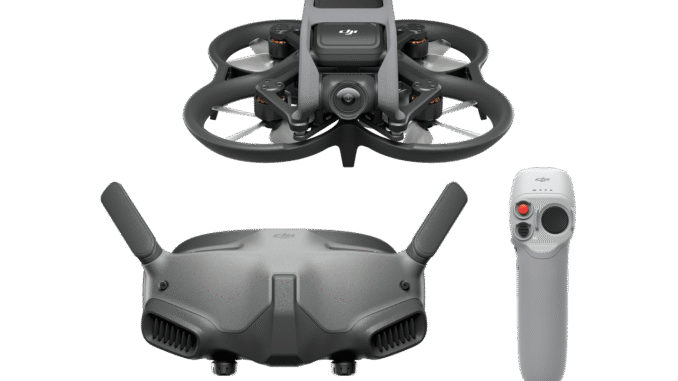
The Short Version
The DJI Avata was the drone that finally made FPV accessible to people who had no intention of becoming FPV pilots. Before it arrived, first-person view flying meant building your own quad, spending months in a simulator, crashing repeatedly, and rebuilding. The Avata changed that deal significantly.
It’s worth being upfront about something before we go any further though: the original Avata is discontinued. DJI replaced it with the DJI Avata 2 in 2024.
You can still find original DJI Avata units on Amazon through third-party sellers, often at reduced prices, but you’re buying remaining stock rather than a current product. We’re covering it here because a lot of people are still flying one, because used and discounted units are genuinely worth considering for the right buyer, and because understanding what the original Avata is helps you make sense of what the Avata 2 improved on. That review is coming shortly.
So is the original Avata still worth buying in 2026? For some people, yes. Read on and I’ll explain who those people are.
What FPV Actually Means
If you’ve never flown an FPV drone, a quick explanation might be useful before we get into the hardware.
FPV stands for first-person view. Instead of watching a screen while the drone hovers in front of you, you put on goggles and see what the drone’s camera sees in real time. You’re not watching the drone fly. You’re flying it from the inside. When you bank left, the whole world tilts. When you dive, you feel it. It’s a completely different experience from flying a traditional camera drone, and for a lot of people it’s immediately and, obviously, more fun.
The trade-off, traditionally, has been that FPV is hard. Custom FPV quads have no safety features, no obstacle avoidance, no GPS hold. You let go of the sticks and the drone falls. Getting good at it takes real time and practice. The Avata was DJI’s answer to the question of whether that trade-off was actually necessary.
What You’re Getting
 The DJI Avata weighs 410g / 14.4oz and shoots 4K/60fps video with a 1/1.7-inch CMOS sensor and a 155-degree field of view. That ultra-wide angle is the right choice for FPV. The immersive feeling you get from first-person flight comes partly from having the world fill your vision, and a narrow lens would undercut that considerably.
Video quality is decent for what the Avata is designed for. You get dynamic footage, close-to-subject flying, that sense of speed and presence that FPV delivers. Where it falls short is in the situations where you’d want a traditional camera drone. The 1/1.7-inch sensor is smaller than what you get in the Mini 4 Pro or Air 3, dynamic range is limited, and low-light performance is noticeably weaker. But you wouldn’t reach for an FPV drone to shoot a slow, deliberate landscape anyway. These are different tools for different intentions.
One genuinely useful feature is the 20GB of internal storage. On a drone where you might not always remember to grab your microSD card before a spontaneous session, having storage built in is more useful than it might sound on a spec sheet.
Photos top out at 4000 x 3000 JPEG. There’s no RAW option. For anyone serious about photography, that’s a limitation worth knowing upfront.
Flying the DJI Avata
This is where the DJI Avata earns its reputation, and honestly where the whole point of it becomes clear.
The Motion Controller is what makes it work for people who’ve never flown FPV before. You hold it in one hand, tilt it in the direction you want to fly, and the drone follows. Squeeze the trigger to go forward. Swivel your wrist to turn. There’s no throttle management in the traditional sense, no coordinating two sticks simultaneously. Most people get comfortable with it within the first few minutes of flying.
The Emergency Brake button is the other thing that makes the Avata genuinely beginner-friendly. One press and the drone stops immediately and holds position. That one feature changes how confidently you fly. Knowing you can freeze the drone at any moment means you take it into tighter spaces and faster maneuvers than you would without it. Panic causes a surprising number of crashes, and having a reliable panic button removes most of the panic.
The ducted propeller guards are built into the frame rather than being bolt-on additions. They protect the props in a crash and they protect whatever the drone hits. Flying indoors or close to obstacles is genuinely viable in a way it isn’t with an unguarded quad. The guards do add some drag and reduce efficiency slightly, but for the audience the Avata was designed for, that’s clearly the right call.
Flight time is rated at 18 minutes. In the real world, expect somewhere between 12 and 15 minutes with typical flying. Push it aggressively and you’ll see less. That’s the Avata’s weakest number and there’s no way to spin it into something it’s not. Plan on at least two batteries for a useful session.
The Avata also has a Manual mode for pilots who want to get closer to the traditional FPV experience. It disables most of the assistance features and lets you fly on sticks with more of the feel of a custom build. It’s not full acro in the way experienced FPV pilots would recognise, but it’s a meaningful step up from Normal mode for anyone who wants to develop their skills past the assisted flying stage.
The Goggles Question
 The DJI Avata is compatible with DJI Goggles 2, DJI Goggles Integra, and the older DJI FPV Goggles V2. It is not compatible with the newer Goggles 3 that ship with the Avata 2, which is worth knowing if you’re considering buying used and already have newer DJI goggles in the house.
If you’re buying an original Avata bundle, look for one that includes Goggles 2 rather than the older FPV Goggles V2. The Goggles 2 have a better screen and a more comfortable fit, and the difference is noticeable in use.
You can fly the Avata without goggles using the FPV Remote Controller 2 and your phone for a live feed, but that defeats most of the purpose. The immersive experience is the point. Without goggles you’re just flying a slightly odd-looking camera drone.
Registration and Regulations
At 410g / 14.4oz the DJI Avata is well above the 250g threshold that Mini series drones operate under. FAA registration is required in the US for all flights, recreational or commercial. Registration costs $5, lasts three years, and is done at faadronezone.faa.gov. Recreational pilots still need the free TRUST test. Commercial pilots need Part 107 certification.
The Avata is FAA Remote ID compliant. In Europe, regulations vary by country, and at this weight the Avata sits in a higher regulatory category than sub-250g drones in most EU markets. Check your national aviation authority before flying to see which rules you have to comply with.
The Honest Case For and Against Buying One Now
The original Avata launched at $629 for the drone only and around $1,388 for the Pro-View Combo with Goggles 2. In 2026, with remaining stock on Amazon through third-party sellers, you’ll likely find it at a meaningful discount. That’s the main argument for buying one in 2026 rather than stepping straight to the DJI Avata 2.
The arguments against are real though. It’s discontinued, which means major future feature updates are unlikely (though occasional maintenance/support updates may still appear), and sourcing replacement parts or getting repairs done will only get harder over time. The sensor is smaller than the Avata 2’s (1/1.7-inch versus 1/1.3-inch), the flight time is shorter (18 minutes claimed versus 23), and it doesn’t have One-Push Acrobatics. It is also not compatible with Goggles 3 which matters if you want to keep your equipment current.
If the price gap between a discounted original Avata and the Avata 2 is significant enough to matter to your budget, and you want to try FPV before committing to a bigger spend, the original Avata still does everything it was designed to do. It’s just no longer the best version of it. That position has been taken by the DJI Avata 2.
How It Compares
| Model | Weight | Sensor | Video | Flight Time | Status |
|---|---|---|---|---|---|
| DJI Avata | 410g / 14.4oz | 1/1.7-inch | 4K/60fps | 18 min | Discontinued |
| DJI Avata 2 | 377g / 13.3oz | 1/1.3-inch | 4K/60fps | 23 min | Current |
| DJI Avata 360 | 455g / 16oz | Dual 1-inch equiv. | 8K/60fps (360°) or 4K/60fps | 23 min | Current |
The Honest Summary
Consider it if: you find a discounted unit at a price that makes sense compared to the Avata 2, you want to try FPV without a big financial commitment, you already have compatible DJI Goggles 2 or FPV Goggles V2, or you want a crash-resistant drone for indoor flying and you don’t need the latest features.
Look elsewhere if: you want a drone with ongoing manufacturer support and firmware updates, you’re buying new at prices close to the original retail price while the Avata 2 is also within reach, you need compatibility with newer DJI goggles, or image quality is a priority.
The original Avata proved something important when it launched: FPV doesn’t have to be intimidating. And in its own right the Avata remains a good drone. It’s just been superseded as happens with almost every model eventually.
Specs
| Weight | 410g / 14.4oz |
| Camera sensor | 1/1.7-inch CMOS |
| Photos | 48MP JPEG (no RAW) |
| Video | 4K/60fps, 2.7K/120fps, 1080p/120fps |
| Field of view | 155 degrees |
| Internal storage | 20GB |
| Flight time | 18 min claimed / 12-15 min real world |
| Range | 10km / 6.2 miles (FCC), 6km / 3.7 miles (CE) |
| Transmission | DJI O3+ |
| Propeller guards | Ducted, built-in |
| Compatible goggles | DJI Goggles 2, Goggles Integra, FPV Goggles V2 |
| FAA Remote ID | Compliant |
| Max speed | 97 km/h / 60 mph (Manual mode) |
Common Questions
Is the original Avata still worth buying in 2026? It depends on the price. If there’s a meaningful discount over the Avata 2 and you want to try FPV without a bigger spend, it still does what it was designed to do. At anything close to original retail though, the Avata 2 is the better buy.
Does the DJI Avata need FAA registration? Yes. At 410g it’s well over the 250g threshold. Registration is $5 for three years at faadronezone.faa.gov. Recreational pilots also need the free TRUST test.
Is the Avata compatible with Goggles 3? No. The original Avata works with Goggles 2, Goggles Integra, and FPV Goggles V2. If you have Goggles 3 from an Avata 2 or another newer DJI product, they won’t work with the original Avata.
Can the Avata do real acro? There is a Manual mode that disables most assistance features, but it’s not full freestyle acro the way experienced FPV pilots would define it. You can develop real stick skills on it, but if you eventually want to fly a custom build, you’ll notice the difference.
Do I need goggles? Technically no, you can use the RC controller and a phone. But the goggles are what makes FPV actually feel like FPV. Without them you’re missing what the whole thing is about.
Where to Buy
- Amazon – check current price (drone only, third-party stock)
- Amazon – check current price (Pro-View Combo with Goggles 2)
Note: The original Avata is discontinued. Stock and pricing on Amazon are from third-party sellers and will vary.
Disclosure: Links above are affiliate links. If you buy through them I earn a small commission at no extra cost to you. It doesn’t affect what I recommend.
Rating
| Image quality | 6.5/10 |
| Flight time | 5.5/10 |
| Ease of use | 9/10 |
| Value (2026, discounted) | 7/10 |
| Overall | 7/10 |
Related Reading
First published: May 2026.

Leave a Reply