
The Short Version
This DJI Air 3 review obviously reflects my personal point of view but then, if you were looking for generic marketing material you wouldn’t be here to begin with so let’s get to it.
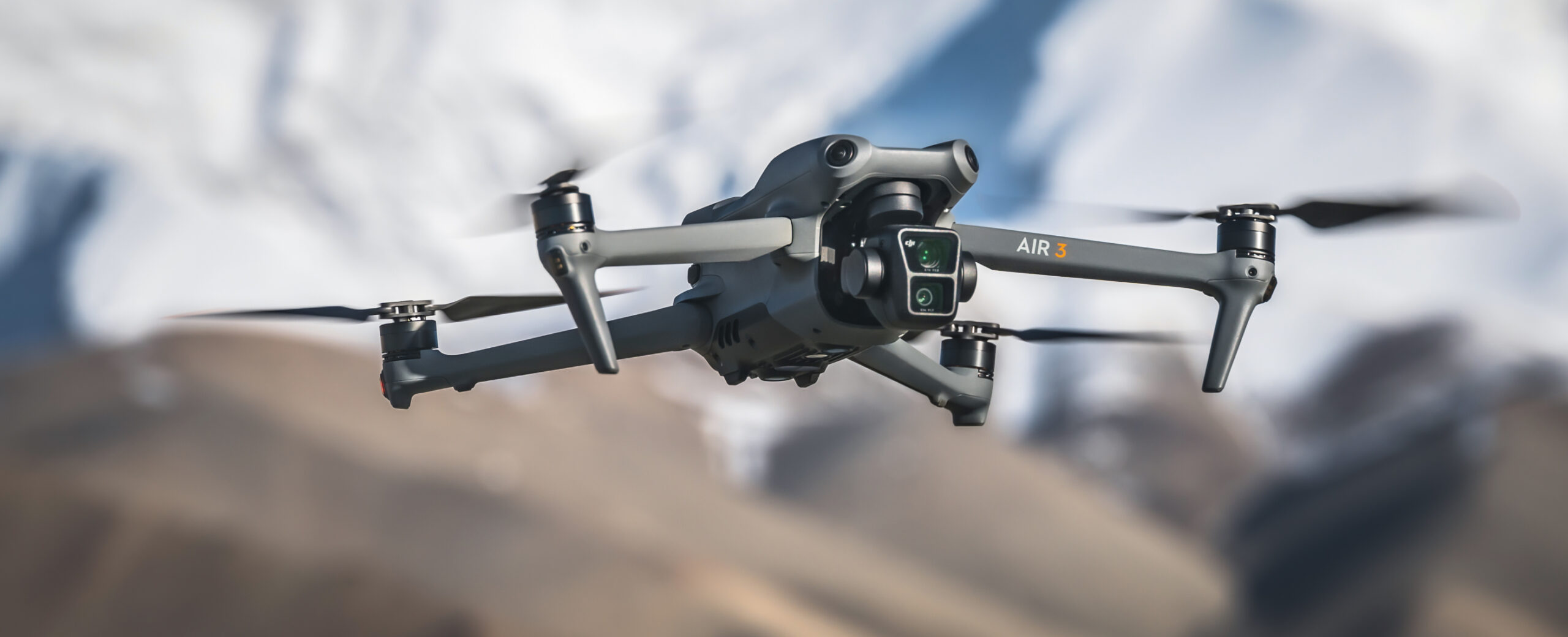
The DJI Air 3 is the drone you buy when the Mini series starts to feel like it isn’t quite enough for you anymore. Not because the Mini drones are bad, they’re not. As I’ve said elsewhere on this site, the Mini 4 Pro and even the Mini 3 are excellent drones for most people and the Mini 5 Pro is even better. But the DJI Air 3 offers something none of the Mini series can match: two cameras, both capable of shooting 4K/60fps with 10-bit D-Log M. And all of this in a package that still fits in a backpack.
This dual camera setup might seem like yet another gimmick but it’s not. It genuinely changes how you can shoot and I will explain why in a moment. But there are also a few things about the DJI Air 3 worth being clear about upfront, starting with the fact that it weighs 720g / 1.59 lbs. That puts it well above the 250g registration threshold, which means it requires FAA registration in the US for all flights, recreational or commercial. And in the rest of the world it also means that, in most countries anyway, you’ll have to deal with additional regulations. If you’ve been flying Mini series drones and are used to not thinking about registration, this means you will have to make a meaningful change in your approach to flying.
The Dual Camera System
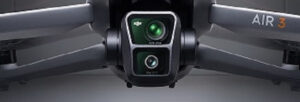
The DJI Air 3 has two cameras that are both mounted on the same 3-axis gimbal: a 24mm wide-angle lens and a 70mm medium telephoto lens with 3x optical zoom. Both of these lenses use the same 1/1.3-inch CMOS sensor and they both shoot 4K/60fps in 10-bit D-Log M. So this isn’t just a case of a flagship camera that got paired with a compromised secondary lens to make it sound good in the specs and the promo material but instead both cameras are really capable. And, of course, you can switch between the two cameras while you are in flight.
In practice this means that the DJI Air 3 gives you two completely different creative options to choose from. And you can use both of these without having to call the drone back and changing the setup (assuming you can even do that to begin with) every time you want to switch it up. The wide angle gives you those gorgeous sweeping landscape shots that aerial photography is known for while the telephoto lens lets you compress perspective, isolate a subject from its background, or get closer to something without disturbing it by actually having to fly closer to it. For filming people, wildlife, architecture, or anything where you want to maintain distance while still filling the frame, this is really useful. So it’s definitely more than just a spec sheet talking point. And the fact that we can easily switch while we’re flying is the icing on the cake for me.
Both the wide angle and the telephoto option shoot 48MP RAW still images in DNG format. You of course have the option to shoot JPEG as well so you are not forced to use DNG if you don’t want to. But for the serious photographers this is a huge step up from the JPEG-only images that the Mini 3 offers as DNG gives you a lot more flexibility and control when you are editing in post.
One honest note about the sensor that I feel I have to add, the 1/1.3-inch sensor that is used in the DJI Air 3 is still the same size as the sensor that DJI put in the Mini 4 Pro. So if you are coming from the Mini 4 Pro specifically then the sensor won’t be an upgrade for you. What you are still gaining though is the second camera, the longer flight time, and the 3x telephoto lens. But, you will not be getting better image quality from the wide angle lens as nothing changes in that regard so I wanted to point that out to remove any doubt people may have.
So if you are looking for improved image quality, and especially improved image quality in low light, then the Air 3S with its 1-inch sensor is probably the better drone for you to look at. I will publish a review on the DJI Air 3S as well although I can’t say when exactly that will be. That said, you can automatically get notified when that happens by signing up for the Phantom-Four.com newsletter through this link. I use this newsletter to let you know when new articles are published on Phantom-Four.com. Don’t worry, there won’t be any spam, just the notifications of the new articles when they are published.
Flying the DJI Air 3
At 720g / 1.59 lbs the DJI Air 3 is noticeably more substantial than any of the models in the Mini series. As a result, it handles wind considerably better than the Mini series which matters more than you might think at first. If you’ve ever had a frustrating session with a lighter drone in gusty conditions you know how badly that can affect your footage. The DJI Air 3 is rated for use in wind speeds up to 12 m/s / 26.8 mph, and although that is not much different from the Mini Series, the extra weight of the DJI Air 3 makes it a lot more stable in gusty situations than any of the Mini series drones is in those conditions.
When you are flying you’ll notice the obstacle sensing in the DJI Air 3 is omnidirectional and that it works very well. The APAS 5.0 system detects obstacles in all directions and easily, and smoothly, routes around them with intelligence at a level that we don’t find in some older implementations. The obstacle avoidance also stays active across most shooting modes and it is noticeably more capable than the tri-directional sensing on the Mini 3 Pro while being on par with the Mini 4 Pro’s system, which has proven itself to be very reliable during usage.
That brings us to flight time, how long can we keep the DJI Air 3 up in the air? The flight time is actually one of the Air 3’s strongest points. DJI rates it at 46 minutes, which is the longest of any of the drones that I’ve covered on this site so far. As always though, you should expect the flight time to be a bit lower in the real world as DJI measures it under ideal circumstances, something we rarely encounter when we’re out flying. You can still count on between 35 and 40 minutes of flight time in real world conditions though, which is still very comfortable.
It gives you enough time to scout a location, set up your shots, and execute them without constantly watching the battery indicator. For anyone who has ever felt rushed on a single Mini battery, those extra minutes make for a notable quality of life improvement when you are out flying.
And the DJI Air 3 can go the distance as well. The range of the DJI Air 3 runs up to 20km / 12.4 miles in FCC mode and 10km / 6.2 miles in CE mode (sorry Europe). To get there the DJI Air 3 uses the same transmission system as the Mini 4 Pro (DJI’s O4 transmission system), which is both reliable and responsive so you don’t have to worry about losing connection while you are flying. Again though, the maximum can be affected by real world factors. If you are an experienced pilot you already know this but if you are a new pilot you should be aware that buildings, trees, hills, and mountains are just a few of the things that can affect the maximum transmission distance so do keep that in mind when you are out flying the Air 3.
Registration and Regulations
I think this deserves its own section because it’s very different from the Mini series.
At 720g the DJI Air 3 requires FAA registration in the US, regardless of whether you are flying recreationally or commercially. Registration itself is straightforward, only costs $5 and your registration is valid for 3 years. You can do this at faadronezone.faa.gov and it’s quite straightforward. Aside from the registration, the TRUST test is still required for recreational pilots. For commercial use you will need Part 107 certification, as with any drone. If you are flying recreationally you can register all your drones under one number but if you are flying commercially you’ll have to register each one individually.
In Europe, the DJI Air 3 falls into a different regulatory category than sub-250g drones as well. But as requirements vary by country I unfortunately can’t list them all here. So if you are based in Europe, check your national aviation authority’s rules before you buy the Air 3. The short version is that you’ll need to register and may need additional certification depending on where and how you fly so please keep that in mind.
None of this should be a deal breaker, but if you’ve been flying Mini drones to avoid the registration requirement, you need to be aware this changes when you step up to the Air series.
The DJI Air 3 vs Air 3S Question
The Air 3S launched in late 2024 and sits above the DJI Air 3 in the current lineup. And for good reason as well, the upgrades are real: the Air 3S has got a 1-inch primary sensor instead of the 1/1.3-inch that we find in the Air 3, the LiDAR obstacle sensing it has works in low light, it has 4K/120fps slow motion, and it has improved dynamic range. If you shoot a lot in challenging light conditions, those are meaningful differences and you will notice that in the end result.
The good news is that while the specs of the DJI Air 3 might not be as impressive as those of the Air 3S, the price of the DJI Air 3 has come down since the Air 3S launched. And the lower price makes it more accessible to a lot of people. As the Air 3S launched at $1,099 (current price here) and you can now find the DJI Air 3 available at a meaningful discount (current price). Knowing this,the question becomes whether the upgrades to the Air 3S justify the premium for your specific use case and that is something I can’t decide for you. However, for the majority of recreational flyers not having the newer upgrades will probably not be a dealbreaker.
After all, for most people shooting primarily in decent light conditions, the DJI Air 3 is still an excellent drone and the value at its current discounted price is very strong. For serious low-light work though or for everyone who wants the best image quality available at this size, the Air 3S is probably worth the extra investment.
How It Compares
| Model | Weight | Cameras | Video | Flight Time | Registration (US) |
|---|---|---|---|---|---|
| DJI Air 3 | 720g / 1.59 lbs | Wide + 3x tele | 4K/60fps HDR | 46 min | Required |
| DJI Air 3S | 724g / 1.60 lbs | Wide + 3x tele | 4K/60fps HDR | 45 min | Required |
| DJI Mini 4 Pro | 249g / 0.549 lbs | Wide only | 4K/60fps HDR | 34 min | Not required (recreational) |
The Honest Summary
Buy it if: you’ve outgrown the single-camera limitations of the Mini series, you want the creative flexibility of a wide and telephoto lens in the same flight, you regularly fly in windier conditions where a heavier drone handles better, or you are a content creator or real estate photographer who needs more than 34 minutes of flight time per battery.
Look elsewhere if: you are still happy with your Mini drone and the dual camera system doesn’t solve a specific problem you actually have, you need to stay under 250g for regulatory reasons, low-light photography is your priority and you want the best image quality at this size (look at the Air 3S instead), or budget is tight and the Mini 4 Pro does what you need.
The DJI Air 3 is not for everyone, and it shouldn’t be. It’s a step up in size, weight, cost, and regulatory complexity. But for the right pilot, particularly anyone who has felt limited by having only one focal length in the air this is a drone that opens up real creative possibilities that the Mini series simply can’t match.
Specs
| Weight | 720g / 1.59 lbs |
| Wide camera sensor | 1/1.3-inch CMOS, f/1.7, 24mm equiv. |
| Tele camera sensor | 1/1.3-inch CMOS, f/2.8, 70mm equiv. (3x optical) |
| Photos | 48MP JPEG and DNG RAW (both cameras) |
| Video | 4K/60fps HDR, 4K/100fps slow motion (both cameras) |
| Color profiles | 10-bit D-Log M, 10-bit HLG |
| Flight time | 46 min (rated) |
| Range | 20km / 12.4 miles (FCC) – 10km / 6.2 miles (CE) |
| Obstacle sensing | Omnidirectional (APAS 5.0) |
| Wind resistance | 12 m/s / 26.8 mph |
| Max speed | 21 m/s / 47 mph (Sport mode) |
| Transmission | DJI O4 |
| Storage | microSD |
| FAA registration | Required for all flights |
| Operating temp | -10 to 40°C / 14 to 104°F |
Common Questions
Does the DJI Air 3 need FAA registration? Yes, for all flights in the US, recreational or commercial. At 720g it’s well above the 250g threshold. Registration costs $5 and takes about ten minutes. The TRUST test is also still required for recreational pilots.
What’s the difference between the DJI Air 3 and Air 3S? The Air 3S has a larger 1-inch primary sensor (vs 1/1.3-inch in the Air 3), LiDAR obstacle sensing for low light conditions, and 4K/120fps slow motion. The DJI Air 3 has a slightly longer rated flight time at 46 vs 45 minutes. If your budget stretches to the Air 3S and you shoot in mixed light conditions, it’s worth the extra. If you shoot mostly in good light and the DJI Air 3 is at a meaningful discount, the value case for the DJI Air 3 is strong.
Can I use it for commercial work? Yes, but you need FAA Part 107 certification for commercial use in the US, regardless of drone weight. This is the same requirement for any commercial drone operation.
Is the dual camera system worth it over the Mini 4 Pro? It depends entirely on whether you actually need the telephoto. If you find yourself wishing you could get closer to your subject without flying closer, or if you want perspective compression for more cinematic shots, then yes. If you mainly shoot wide landscape footage and are happy with the Mini 4 Pro results, the DJI Air 3 only solves a problem you don’t have.
Where to Buy
- Amazon – check current price
Disclosure: Links above are affiliate links. If you buy through them I earn a small commission at no extra cost to you. It doesn’t affect what I recommend.
Rating
| Image quality | 9/10 |
| Flight time | 9/10 |
| Creative versatility | 10/10 |
| Value (at current price) | 8/10 |
| Overall | 9/10 |
Related Reading
First published: April 2026.

Leave a Reply